
What is Diamond problem and how is it solved?
The Diamond problem in C++ refers to a common issue in multiple inheritance when a class inherits from 2 classes that share a common base class. This structure forms a diamond-like shape in the inheritance hierarchy, leading to ambiguity.
Consider a scenario where Class A is the base class, and Class B and Class C inherit from Class A. Then, Class D inherits from both Class B and Class C. This creates the diamond shape:
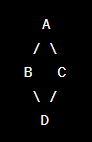
The issue arises when Class D inherits the attributes or methods of Class A through both Class B and Class C, leading to ambiguity in cases where both B and C define the same method or attribute.
To solve the diamond problem, C++ uses virtual inheritance. When a class is virtually inherited, only one instance of the common base class is shared among the derived classes, preventing duplication of inherited members.
To implement virtual inheritance in C++, you would define the inheritance as virtual in the derived classes B and C when inheriting from the common base class A.
The same problem may be seen in Java. So let’s see how it is handled in Java.
In Java, the diamond problem is resolved by not allowing multiple inheritances like C++ does. Java doesn’t support multiple inheritances to avoid such conflicts.
Instead, Java uses interfaces to provide a form of multiple inheritance in a controlled and safe manner. A class can implement multiple interfaces, which define abstract methods, but it can only extend a single class.
For instance, consider a scenario where you have two interfaces, InterfaceA and InterfaceB, each declaring a method commonMethod(). Then a class, classC, implements both interfaces:
interface InterfaceA {
    void commonMethod();
}

interface InterfaceB {
    void commonMethod();
}

class classC implements InterfaceA, InterfaceB {
    // Implement the commonMethod defined in InterfaceA
    public void commonMethod() {
        // Method implementation for InterfaceA
    }
}
By implementing multiple interfaces that might contain methods with the same signature, a class can provide specific implementations for each method separately, avoiding conflicts.
In Java, this approach allows the class to provide its own implementation for methods declared in multiple interfaces without running into the diamond problem, as it does not inherit conflicting implementations from multiple parent classes

 DevScript Saga
Leave a comment